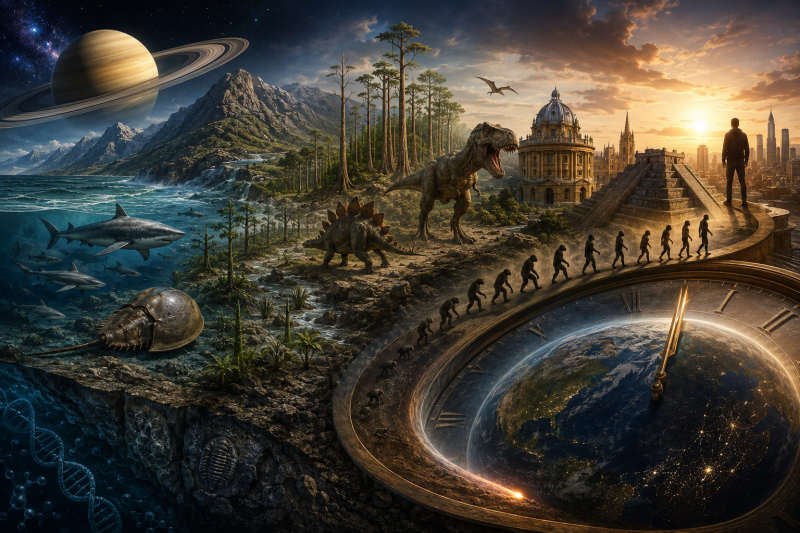
Our brains handle days, years, and maybe even centuries reasonably well. But once you start talking about millions of years, or comparing ancient civilizations to modern events, our sense of time begins to fall apart. Things we assume existed together often lived worlds apart, while events that feel impossibly distant can be surprisingly close on the grand timeline of history.
Here are six facts that might completely change how you think about time.
The Appalachian Mountains Are Older Than Saturn's Rings
When most people think of something ancient, they imagine a planet, a star, or perhaps even the rings of Saturn. Yet the Appalachian Mountains in eastern North America are older than Saturn's famous rings.
The Appalachians began forming roughly 480 million years ago during a series of continental collisions that helped build ancient supercontinents. At one point, these mountains may have rivaled the modern Himalayas in height. Since then, hundreds of millions of years of erosion have sculpted them into the rolling ridges we see today.
Saturn itself formed about 4.5 billion years ago, but evidence from the Cassini mission suggests its bright rings may be surprisingly young, perhaps only 100 to 400 million years old. While the exact age remains debated, the possibility remains that the rocks beneath your feet in the Appalachians were already ancient before Saturn acquired its most recognizable feature.
Sharks Are Older Than Trees
Sharks have been swimming through Earth's oceans for around 450 million years. They appeared long before dinosaurs, mammals, birds, or even forests.
The first true trees did not evolve until roughly 385 million years ago. That means sharks had already existed for more than 60 million years before the first forests appeared on land.
Imagine standing on an ancient shoreline. The seas are filled with shark ancestors, but the continents are largely barren. No towering pines. No oak forests. No autumn leaves. Sharks were already thriving in the oceans before Earth had trees.
Horseshoe Crabs Are Older Than Dinosaurs
If sharks being older than trees sounds unbelievable, horseshoe crabs take things even further.
Ancestors of modern horseshoe crabs first appeared around 445 million years ago. Dinosaurs would not evolve until roughly 230 million years ago, meaning horseshoe crab lineages had already existed for more than 200 million years before the first dinosaur ever took a step.
These remarkable animals survived every major mass extinction event, including the catastrophe that wiped out the dinosaurs. Their overall body plan has changed so little that they are often called "living fossils," offering a glimpse into ecosystems that existed hundreds of millions of years before the age of dinosaurs.
Tyrannosaurus rex Lived Closer to Us Than to Stegosaurus
Popular culture often treats dinosaurs as if they all lived together. In reality, many famous species were separated by enormous spans of time.
Stegosaurus lived about 150 million years ago during the Late Jurassic. Tyrannosaurus rex appeared much later, around 68 million years ago during the Late Cretaceous.
More than 80 million years separated the two species.
To put that into perspective, only about 66 million years separate T. rex from modern humans. In other words, T. rex lived closer in time to us than it did to Stegosaurus. Despite appearing side by side in countless books, movies, and toy sets, the two animals never shared the same world.
Oxford University Is Older Than the Aztec Empire
Not all timeline surprises come from geology and paleontology.
Teaching was already taking place at Oxford University in England by approximately 1096. Students were attending lectures and scholars were debating ideas centuries before the rise of the Aztec Empire.
The Aztec Empire was founded in 1428, more than 300 years after Oxford had already begun educating students.
We often group both into the category of "old history," yet one existed for centuries before the other even began.
Compressing Earth's History into a Single Year
Perhaps the best way to understand deep time is to shrink Earth's entire 4.54-billion-year history into a single calendar year.
On this scale, Earth forms on January 1.
For most of the year, life consists only of microscopic organisms. Complex animals do not appear until late November. Dinosaurs arrive around December 13 and dominate the planet for nearly two weeks.
Then, on December 26, an asteroid impact contributes to the extinction event that ends their reign.
Modern humans do not appear until the final minutes before midnight on December 31.
All of recorded history, from the great pyramids and Roman Empire to the Industrial Revolution, smartphones, and spaceflight, takes place in the last few seconds before the clock strikes midnight.
A Humbling Perspective
These comparisons highlight just how difficult it is for humans to comprehend vast stretches of time. The next time you hike a mountain trail, visit a museum, look up at Saturn, or watch waves roll onto a shoreline, remember that you are seeing only a tiny snapshot of a story billions of years in the making. Earth has been writing that story for a very long time, and we've only just arrived for the last page.
Add comment
Comments