
The Boötes Void and the Virgo Cluster — Two Extremes of the Cosmic Web
Introduction
When most people imagine space, they picture a vast emptiness dotted with stars and galaxies. In reality, the universe is far more structured than that. Galaxies are not scattered randomly through space. Instead, they form an immense cosmic web made up of filaments, clusters, and enormous empty regions known as voids.
Few places better demonstrate these extremes than the Boötes Void, one of the largest known voids in the observable universe, and the Virgo Cluster, one of the nearest and most densely populated galaxy clusters to Earth. One represents a cosmic desert; the other, a bustling galactic metropolis. The contrast between these two structures reveals just how unevenly matter is distributed throughout the cosmos.
The Cosmic Web: The Universe's Hidden Structure
On the largest scales, matter in the universe resembles a three-dimensional spiderweb. Galaxies gather along long filaments of dark matter and gas, intersecting at massive clusters containing hundreds or even thousands of galaxies. Between these structures lie enormous voids where very little matter exists.
This arrangement is known as the cosmic web. It formed over billions of years as gravity amplified tiny density fluctuations left behind by the Big Bang. Regions with slightly more matter attracted additional material, growing into galaxy clusters and filaments. Regions with slightly less matter lost material to their denser neighbors and gradually became the immense voids we observe today.
Far from being random, the universe has a surprisingly organized large-scale structure. Understanding that structure helps astronomers investigate dark matter, dark energy, galaxy formation, and the evolution of the cosmos itself.
The Boötes Void: The Great Nothing
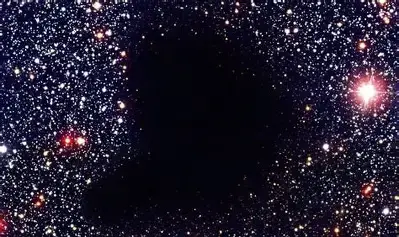
Discovered in 1981 by astronomer Robert Kirshner and his colleagues, the Boötes Void lies approximately 700 million light-years from Earth in the direction of the constellation Boötes. Measuring roughly 330 million light-years across, it remains one of the largest known voids in the observable universe.
To appreciate its scale, consider that our entire Local Group, which includes the Milky Way, Andromeda, and dozens of smaller galaxies, is only about 10 million light-years across. The Boötes Void is large enough to contain dozens of Local Groups side by side.
Astronomers expected thousands of galaxies to occupy a region of that size. Instead, only a few dozen have been identified. Although the void is not completely empty, its galaxy density is extraordinarily low compared to the surrounding universe.
If a civilization existed near the center of the Boötes Void, its night sky would likely appear far less crowded than ours. Many of the bright neighboring galaxies that populate our cosmic neighborhood simply would not be there.
For years, astronomers debated how such a vast empty region could exist. Today, computer simulations of cosmic evolution successfully reproduce giant voids as a natural outcome of structure formation. As matter migrated toward denser regions, less dense areas expanded and became increasingly empty, creating enormous cosmic deserts like the Boötes Void.
Even with this explanation, it remains one of the most striking and humbling structures ever discovered, a reminder that much of the universe consists not of galaxies, but of vast expanses of almost nothing.
The Virgo Cluster: A Galactic Metropolis
If the Boötes Void represents cosmic isolation, the Virgo Cluster represents cosmic congestion.
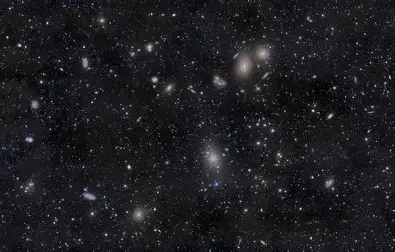
Located approximately 54 million light-years from Earth in the constellation Virgo, the Virgo Cluster contains between 1,300 and 2,000 galaxies. It forms the gravitational center of the larger Virgo Supercluster, which includes our own Milky Way Galaxy.
Unlike the emptiness of the Boötes Void, galaxies within the Virgo Cluster exist in close proximity to one another. Their mutual gravity creates a chaotic environment where galaxies frequently interact, collide, and merge. These encounters can reshape the long-term evolution of entire galaxies.
At the cluster's center lies the giant elliptical galaxy Messier 87 (M87), one of the most massive galaxies in the nearby universe. M87 contains trillions of stars and hosts a supermassive black hole with a mass billions of times greater than that of the Sun.
In 2019, the Event Horizon Telescope collaboration captured humanity's first direct image of a black hole by observing M87's central black hole. The famous orange ring image became one of the most important astronomical achievements of the modern era.
The Virgo Cluster also contains enormous quantities of extremely hot gas, heated to millions of degrees. This gas emits powerful X-rays and actually contains more mass than all the visible stars within the cluster's galaxies combined.
For astronomers, the Virgo Cluster serves as a natural laboratory where they can study galaxy interactions, dark matter, black holes, and the processes that shape the universe on the largest scales.
A Matter of Perspective
The Boötes Void and the Virgo Cluster represent opposite ends of the cosmic spectrum.
One is an immense region where galaxies are surprisingly scarce. The other is a crowded collection of thousands of galaxies bound together by gravity. Yet both emerged from the same universe, evolving over nearly 14 billion years.
The next time you look up at the night sky, remember that the stars above are only a tiny part of a much larger cosmic landscape. Beyond the reach of human vision lie vast galactic cities like the Virgo Cluster and enormous cosmic deserts like the Boötes Void.
Together they reveal one of astronomy's most remarkable truths: the universe is not uniformly filled with matter. Instead, it is a colossal web of crowded intersections and empty expanses stretching across billions of light-year, a structure so immense that it challenges our very ability to comprehend it.
Add comment
Comments