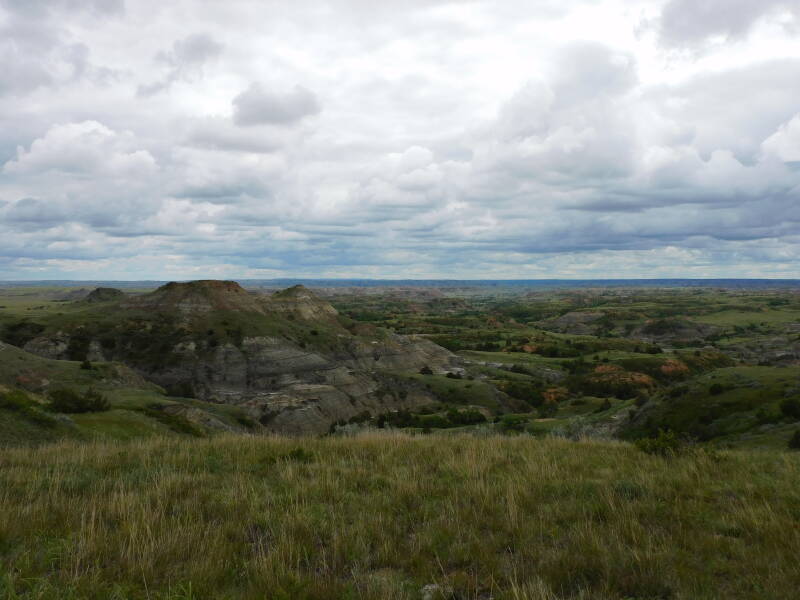
This summer, I had the incredible opportunity to spend two days volunteering with an archaeologist from the U.S. Forest Service in Watford City, North Dakota. Over those two days, we visited several known archaeological sites just north of the North Dakota Badlands, documenting artifacts and learning about the people who once called this landscape home. Some of the sites we visited even contained evidence dating back to Paleoindian times, making the experience feel like stepping directly into the deep history of the Northern Plains.
A Rich Native American History
Humans have lived in what is now North Dakota for more than 13,000 years. The earliest known inhabitants, known as Paleoindians, arrived near the end of the last Ice Age and likely followed herds of mammoths, ancient bison, and other large game across the Great Plains. Over thousands of years, these early hunter-gatherers adapted to changing climates and landscapes.
Later cultures, including the Plains Archaic and Woodland peoples, continued to utilize this region before eventually giving way to the historic tribes that many associate with the Northern Plains today, including the Mandan, Hidatsa, Arikara, and Sioux. The area surrounding the Little Missouri River served as an important hunting ground, travel corridor, and seasonal home for countless generations of Native Americans.
Discovering the Past
Across the three sites we visited, we documented dozens of artifacts that provided a glimpse into everyday life thousands of years ago.
One of the most common artifacts we encountered were flakes. These are small pieces of stone that break off while making tools from materials such as chert, flint, or porcellanite. While they may look insignificant at first glance, flakes are often some of the most important clues archaeologists use to identify ancient campsites and understand how people manufactured their tools.
We also found numerous examples of fire-cracked rock. These are stones that have been fractured and altered after repeated heating and cooling, often from use in campfires or heating stones for food preparation. Fire-cracked rock is another important indicator of human activity and often points to areas where people lived and cooked.
Other artifacts included projectile points, scrapers, and various worked pieces of stone tools that can hint at the many tasks carried out at these camps.
Beyond artifacts, we also encountered several cultural features. We found cairns, which are piles of rocks intentionally placed to mark locations or important features on the landscape. Perhaps even more impressive were the stone circles left behind by teepee camps.
The circles we visited measured roughly five meters across and would have supported teepees around sixteen feet tall. Some stone circles in the region are even larger, reaching nearly nine meters across and supporting structures around twenty feet tall. Standing in these circles and realizing that families once lived, cooked, and slept in these exact locations was an incredibly humbling experience.
A Landscape That Tells a Story
One of the most memorable aspects of the experience was simply taking in the landscape itself.
From these campsites, the views stretched endlessly across the northern prairies, while to the south the rugged badlands rolled toward the Little Missouri River. It was easy to understand why Native Americans chose these locations.
You could practically picture the open prairie filled with massive herds of grazing bison. The elevated ridgelines offered excellent vantage points for spotting game, while also serving as natural travel corridors leading toward the river and its resources.
Standing there, surrounded by the same views that people experienced hundreds and even thousands of years ago, made the past feel incredibly real.
Reflections
Archaeology has a unique way of connecting people to a landscape. Every flake of chert, every fire-cracked rock, and every circle of carefully placed stones represent a moment in someone's life that occurred long before our own.
For two days, I had the privilege of walking through that history, and it gave me an entirely new appreciation for the people who lived, traveled, and thrived in western North Dakota long before the modern world arrived.
Add comment
Comments