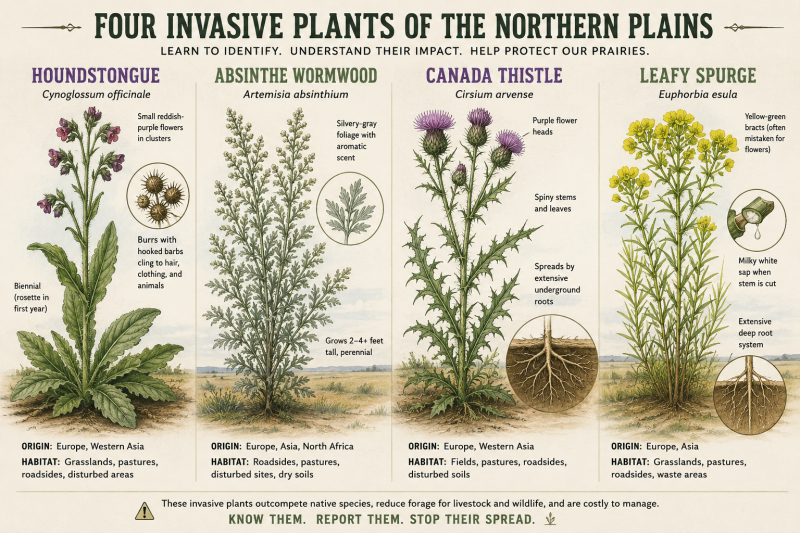
The Northern Great Plains are home to one of North America's most diverse and productive grassland ecosystems. However, these prairies face an ongoing threat from invasive plant species that outcompete native vegetation, alter wildlife habitat, and create challenges for land managers. During my time working in North Dakota, I've spent countless hours battling four of the region's most notorious invaders: houndstongue, absinthe wormwood, Canada thistle, and leafy spurge.
Houndstongue (Cynoglossum officinale)
A European Hitchhiker
Houndstongue is native to Europe and parts of western Asia. It was introduced to North America in the mid-1800s, likely arriving accidentally in contaminated crop seed and livestock feed. Since then, it has spread throughout much of the western United States and Canada.
Identifying the Invader
The plant forms a basal rosette of large, fuzzy leaves during its first year before producing tall stems and reddish-purple flowers in its second year. Its most recognizable feature is its seeds, small burrs covered in hooked barbs that cling to clothing, fur, and even vehicle tires.
Why It Matters
Houndstongue is especially problematic because it produces chemicals that inhibit the growth of neighboring plants, a process known as allelopathy. It reduces native plant diversity, degrades rangelands, and poses a threat to livestock. The plant contains pyrrolizidine alkaloids, compounds that can cause liver damage in grazing animals if consumed in sufficient quantities.
The burrs are equally troublesome, attaching themselves to wildlife and livestock alike. Anyone who has walked through a patch of mature houndstongue knows that you'll be picking seeds off your clothes for the rest of the day.
Absinthe Wormwood (Artemisia absinthium)
A Bitter Introduction
Absinthe wormwood, often simply called wormwood, is native to Europe, Asia, and northern Africa. It was intentionally brought to North America during the 1800s for medicinal purposes and for the production of the alcoholic spirit absinthe.
Identifying the Invader
Wormwood is a perennial plant with silvery-gray foliage and a distinctive aromatic smell when crushed. It can grow over four feet tall and often forms dense stands along roadsides, disturbed areas, and pastures.
Why It Matters
Wormwood spreads aggressively and competes strongly with native grasses and forbs. Because it contains bitter compounds, livestock generally avoid grazing it. This gives the plant an advantage over surrounding vegetation, allowing it to spread and dominate areas that would otherwise support native prairie species.
Canada Thistle (Cirsium arvense)
Not Actually Canadian
Despite its name, Canada thistle is native to southeastern Europe and western Asia. It arrived in North America during the 1600s, likely as an unwanted contaminant in crop seed.
Identifying the Invader
Canada thistle forms colonies of spiny stems topped with purple flowers. Unlike many thistles, it spreads extensively through underground roots. These roots can extend several feet and produce new shoots from even tiny root fragments.
Why It Matters
This plant is one of the most frustrating weeds to manage because pulling or cutting it often stimulates additional growth. A single patch can quickly become an expansive colony connected by an underground network of roots.
Canada thistle outcompetes native vegetation, reduces forage production, and forms dense patches that limit access for both wildlife and livestock. Its persistence has earned it a place on noxious weed lists throughout much of North America.
Leafy Spurge (Euphorbia esula)
Public Enemy Number One
Leafy spurge may be the most infamous invasive plant in the Northern Plains. Native to Europe and Asia, it was accidentally introduced to North America in the 1800s through contaminated seed shipments.
Identifying the Invader
The plant is recognizable by its narrow leaves and bright yellow-green bracts that are often mistaken for flowers. Break a stem and a milky white sap immediately appears.
Why It Matters
Leafy spurge is incredibly resilient. It can spread both by seed and through an extensive root system that reaches deep into the soil. Seeds can remain viable for years and are capable of being launched several feet from the parent plant.
The plant contains compounds that irritate the mouths and digestive systems of cattle, causing most livestock to avoid it. As a result, leafy spurge often expands unchecked, replacing diverse native plant communities with nearly pure stands of itself.
Across the Northern Great Plains, leafy spurge has cost landowners and conservation agencies millions of dollars in lost forage production and control efforts. It is one of the most economically damaging invasive plants in the region.
Fighting Back on the Prairie
Working in land management has given me a front-row seat to the challenges these species create. Every patch of houndstongue, every field of wormwood, and every stubborn stand of thistle or leafy spurge represents more than just another weed. They are reminders of how easily ecosystems can be altered and how much effort it takes to restore native landscapes once invasive species gain a foothold.
Working at Cross Ranch really put these species into perspective for me. Of all these invaders, I’ve found wormwood to be the least prairie-altering. Across the thousands of acres we treated, I only encountered one major infestation. Canada thistle isn’t far behind in my experience, usually appearing in smaller, scattered patches rather than dominating large areas. That said, wormwood and Canada thistle often seem to go hand in hand, where there’s one, there’s usually the other.
Houndstongue and leafy spurge, on the other hand, have been by far the most threatening. Houndstongue thrives in disturbed areas, especially along prairie edges and in the Missouri River bottoms. It can be surprisingly difficult to manage, not just because of where it grows, but because first-year plants are hard to identify. They blend in with surrounding grasses and can resemble native young growth, making early detection a real challenge.
Leafy spurge is the one that truly baffles me. It’s a battle that’s been going on for decades, and it feels like it never really ends. It’s incredibly resilient, just when you think you’ve knocked it back, it comes roaring back the next year. I’ve seen data from plots surveyed in 2023 that should have had only 10 to 50 plants per acre, but now support 500 to 1,000. Seeing that kind of rebound firsthand really drives home how persistent and difficult this species is to control.
So, How Do We Fight Back?
The honest answer? I don't think anyone has a perfect solution yet.
We've been fighting some of these species for decades. Agencies, landowners, and conservation groups have spent millions upon millions of dollars trying to control them through every method imaginable. But a question I've struggled with while working in prairie management is this: even if we successfully remove an invasive species from an area, how long does that success actually last?
Five years?
Ten years?
Maybe twenty if we're lucky?
At some point, we have to ask ourselves whether we're truly solving the problem or simply delaying it.
There are several ways to combat invasive plants, and each comes with its own benefits and drawbacks.
Mechanical Removal
The simplest method is physically removing the plants by hand or with equipment. In theory, this sounds great. In practice, it takes a tremendous amount of time and manpower, and it's not always that easy.
Species like Canada thistle and leafy spurge have extensive underground root systems. Unless you remove the entire root network, you're often not eliminating the plant at all. You're simply setting it back temporarily before it re-sprouts.
You also have to be extremely careful not to spread seeds in the process. Pulling mature houndstongue or disturbing seed-producing plants can unintentionally help these invaders colonize new areas.
Chemical Control
Herbicides are another common tool, and they're often highly effective at reducing infestations in the short term. However, chemical control raises its own concerns.
There is the obvious issue of exposure to the people applying these chemicals, but there is also the question of what repeated applications mean for the ecosystem itself.
Some management approaches involve broad-scale spraying, coating entire landscapes in hopes that the invasive plants die and the native species recover afterward. Others, like the work I've done this summer, rely on spot spraying individual plants or small patches.
Even with spot spraying, you're still impacting the native species immediately surrounding those invasives. And getting to those infestations often means driving UTVs, ATVs, or trucks across sensitive prairie ecosystems, killing countless wildlife including fawns and ground-nesting birds such as ducks. Sometimes it feels like we're trying to save the prairie while simultaneously damaging parts of it.
Biological Control
Biological control uses one organism to combat another and has shown some promise, such as flea beetles targeting leafy spurge.
However, it is rarely a quick or guaranteed solution. It can take years for introduced species to establish and make an impact, if they survive at all. Even when successful, they typically reduce rather than eliminate invasive species.
While biological control has potential, it appears to be another way of managing invasives rather than solving the problem. This raises the same question: are we eliminating these species, or simply keeping them in check?
Fire
Of all the management tools, prescribed fire may be the one I appreciate the most.
Fire is natural. Prairie ecosystems evolved with it. For thousands of years, fires swept across the Great Plains, recycling nutrients, reducing woody encroachment, and helping maintain healthy grasslands.
Fire can also set back many invasive species.
The downside is that it rarely eliminates them entirely. The native plants return, but so do the invasive species. In many cases, fire simply resets the clock and buys time before the invaders establish themselves once again.
The Bigger Question
I don't claim to have the answer to invasive species management. In fact, I think the biggest question we need to ask ourselves is this:
At what point are we doing more harm than good?
How much money, time, and effort should we continue to invest in battles that may never truly be won? Are we restoring ecosystems, or are we entering into an endless cycle of management that only temporarily suppresses the inevitable?
I don't know the answer.
What I do know is that these invasive species aren't going away anytime soon, and the conversation about how we manage them is far from over.
Add comment
Comments