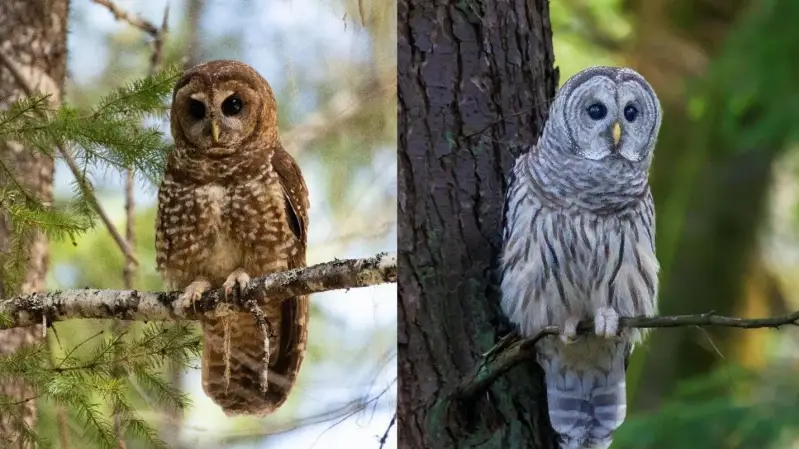
Left: Spotted Owl, Right: Barred Owl
Few wildlife management decisions in recent years have sparked as much debate as the U.S. Fish and Wildlife Service's plan to remove barred owls across parts of the Pacific Northwest. The goal is simple on paper: reduce barred owl populations to help protect the declining northern spotted owl. In practice, however, the issue is anything but simple.
The northern spotted owl has become one of the most recognizable symbols of conservation in the United States. For decades, habitat loss from logging was considered the primary threat to its survival. More recently, another challenge has emerged. The barred owl, a larger and more adaptable relative from eastern North America, has expanded its range westward and now competes directly with spotted owls for food and territory.
Supporters of the removal program point to scientific studies showing that spotted owls often fare better when barred owls are removed from an area. If the goal is preventing the possible extinction of a threatened species, they argue, action is necessary.
Yet this raises an uncomfortable question: should humans be killing one native owl to save another?
Unlike invasive species brought from other continents, barred owls are native to North America. Their expansion into western forests was not the result of a deliberate introduction by humans. Instead, it appears to be a natural range expansion that occurred over the last century. While human alterations to the landscape may have aided their movement, barred owls ultimately arrived and established themselves on their own.
Conservation efforts often focus on correcting problems that humans directly created. We restore habitats destroyed by development. We remove invasive species that were accidentally introduced. We work to reduce pollution and other environmental impacts. The barred owl situation is different. Here, we are attempting to reverse what many would consider a naturally occurring ecological shift.
Nature is constantly changing. Species expand, compete, and adapt. Some thrive while others struggle. It is a process that has occurred for millions of years. From this perspective, the decline of the spotted owl may not represent a failure of conservation but rather an example of natural selection unfolding in real time.
There is also the question of cost. The management plan could require decades of continued removals across millions of acres. Critics have estimated costs reaching into the hundreds of millions, or even billions, of dollars over the life of the program. Regardless of the final number, one fact remains clear: maintaining a large-scale owl removal effort would require substantial long-term funding.
This leads to another difficult question. At a time when conservation agencies face limited budgets, is this the best use of taxpayer dollars? Could those resources achieve greater ecological benefits if directed toward habitat restoration, wetland protection, endangered species recovery, or other conservation priorities?
At the same time, dismissing the program entirely would ignore the legitimate concerns of wildlife biologists. Many researchers have dedicated their careers to studying spotted owls and have documented dramatic population declines. Their concern is not hypothetical. Without intervention, the northern spotted owl could disappear from large portions of its historic range.
That reality deserves consideration.
Ultimately, the barred owl debate forces us to confront a broader question about conservation itself. Should conservation focus primarily on addressing human-caused threats while allowing natural ecological processes to unfold?
There are no easy answers.
The barred owl dilemma sits at the intersection of science, ethics, economics, and philosophy. Whether one views the removal program as necessary conservation or costly overreach often depends on how they answer a simple question:
When nature changes on its own, how much should we try to stop it?
Add comment
Comments