On July 4, 2026, I had the opportunity to visit the newly opened Theodore Roosevelt Presidential Library in Medora, North Dakota. Coinciding with its grand opening, the library welcomed visitors from across the country to celebrate both Independence Day and the legacy of one of America's most influential conservationists. Thanks to my work with the U.S. Forest Service over the holiday weekend, patrolling public lands during the opening festivities, I was fortunate enough to experience the library on its opening weekend.
From the moment I arrived, it was clear this wasn't intended to be a traditional museum. Rather than simply displaying artifacts behind glass, the library encourages visitors to interact with history. Shortly after entering, visitors are offered the opportunity to have their photo taken. While some people may understandably prefer not to participate, those who do are rewarded with personalized experiences throughout the exhibits that make the visit feel surprisingly immersive.
Another memorable touch is the wristband each guest receives upon entry. Beyond serving as admission, it is what allows visitors to interact with nearly every exhibit throughout the library, connecting them to personalized experiences along the way. It also becomes a keepsake, making the visit feel unique and giving guests something to remember long after they leave.
One of the most talked-about exhibits is the opportunity to have a conversation with an artificial intelligence version of Theodore Roosevelt. Visitors can ask questions and receive responses in real time from an AI designed to portray the former president based on his writings, speeches, and historical record. Of course, it is important to remember that this is not Theodore Roosevelt himself, but rather a modern interpretation powered by artificial intelligence. Even so, it provides a fascinating way to engage with history and makes learning about Roosevelt's life feel more personal than simply reading information panels.
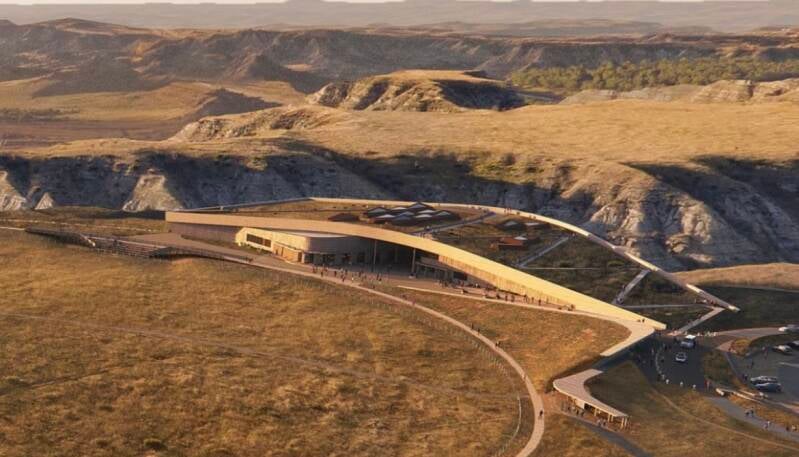
The building itself is equally impressive. The architecture blends remarkably well into the surrounding North Dakota Badlands, offering breathtaking views of the landscape that Roosevelt himself came to love. Large windows frame the rugged scenery, constantly reminding visitors why this region played such a significant role in shaping his views on conservation. Perhaps the most striking architectural feature is the roof. Rather than existing solely as part of the building, it takes inspiration from a land bridge design that visitors can actually walk on. This innovative approach reflects the concept of wildlife crossings, which help reduce wildlife-vehicle collisions while reconnecting habitat on both sides of the road.
One aspect of the library that I found particularly interesting was its extensive use of artificial intelligence. Theodore Roosevelt is remembered as one of America's greatest conservation leaders, having helped establish national forests, wildlife refuges, and numerous national parks. At the same time, artificial intelligence has become a topic of debate in conservation circles. Training and operating large AI systems requires substantial computing power and energy, leading some conservationists to question their environmental footprint. Others argue that AI can also become a valuable conservation tool by assisting with wildlife monitoring, ecological research, and resource management.
Seeing those ideas come together inside the Theodore Roosevelt Presidential Library creates an interesting contrast. A museum dedicated to one of history's greatest conservation advocates embraces one of today's fastest-growing technologies. Rather than viewing that as a contradiction, I found it thought-provoking. It raises questions about how we balance technological innovation with environmental stewardship and how conservation may continue to evolve in the decades ahead.
Overall, I came away impressed. The Theodore Roosevelt Presidential Library successfully blends history, architecture, technology, and conservation into an experience that feels engaging rather than static. Whether you're interested in Theodore Roosevelt, the North Dakota Badlands, innovative architecture, or simply enjoy learning through interactive exhibits, I believe the library is well worth a visit. It serves not only as a tribute to Roosevelt's remarkable life but also as a reminder that preserving history sometimes means embracing new ways to tell it.
Add comment
Comments