When most people think about ancient civilizations, their minds usually drift toward Egypt, Rome, the Maya, or perhaps Machu Picchu high in the Andes. Rarely does anyone picture the American Midwest.
But long before modern cities rose beside the Mississippi River, another city stood there — enormous, complex, and alive with trade, religion, astronomy, and culture. Its name was Cahokia.
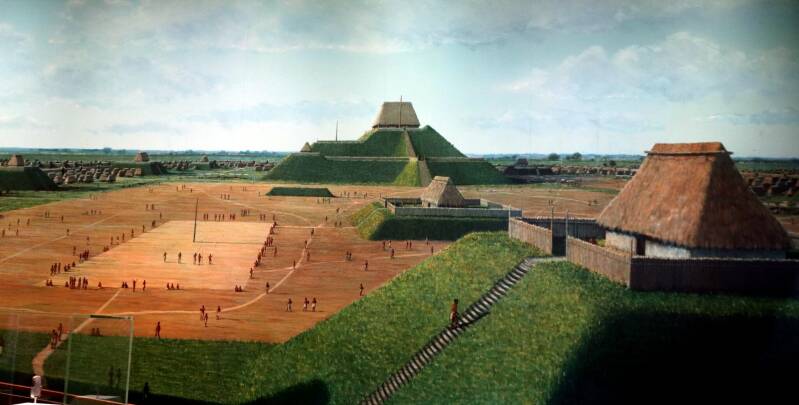
Located near present-day St. Louis, Cahokia was the largest pre-Columbian city north of Mexico. At its height around 1050–1200 CE, it may have housed tens of thousands of people, making it larger than many European cities of the same era. Yet despite its size and significance, many Americans have never even heard of it.
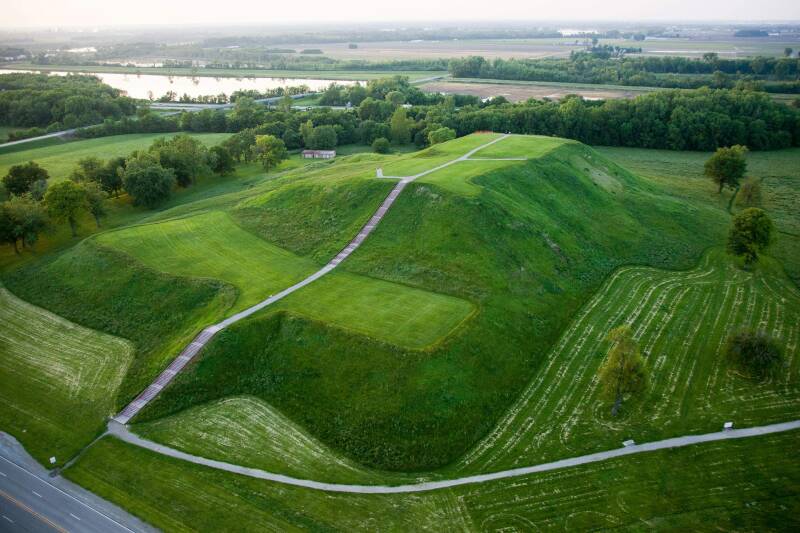
Cahokia was built by the Mississippian people, a culture known for constructing massive earthen mounds across central-eastern North America. The centerpiece of the city, now called Monks Mound, still towers above the surrounding landscape today. Built entirely by hand using baskets of soil carried over generations, the mound rises nearly 100 feet tall and covers more area at its base than the Great Pyramid of Giza.
Think about that for a second.
No modern machinery. No steel equipment. No beasts of burden. Just human effort, planning, and organization on a scale that many people still do not associate with ancient North America.
The city itself was far more than a collection of mounds. Cahokia was an urban center connected to vast trade networks stretching across the continent. Shells from the Gulf Coast, copper from the Great Lakes region, and exotic stone materials all found their way into the city. It was a hub of commerce and ceremony, where politics, spirituality, and daily life intertwined.
The people of Cahokia also understood astronomy with remarkable precision. Archaeologists discovered large timber circles near the site, often referred to as “Woodhenge”, which aligned with solstices and equinoxes. These structures are believed to have functioned as calendars and ceremonial spaces, helping track the changing seasons and reinforcing the city’s spiritual worldview.
Yet like many civilizations throughout history, Cahokia eventually declined.
The reasons are still debated. Environmental strain, deforestation, flooding, political instability, resource depletion, and social unrest may all have played a role. Living beside one of the most powerful river systems on Earth brought both opportunity and danger. Over time, the city emptied, and by the time Europeans arrived in the region centuries later, Cahokia had largely faded from memory.
Today, the mounds remain as quiet reminders that North America held sophisticated societies long before colonization. Cahokia challenges outdated ideas about the continent’s past. It forces us to reconsider what we think civilization looks like and who gets remembered in history books.
Maybe that is why places like Cahokia matter so much.
Not because they are lost, but because they were overlooked.
And standing among those ancient mounds today, it becomes impossible not to wonder how many other stories are still buried beneath our feet.
Add comment
Comments