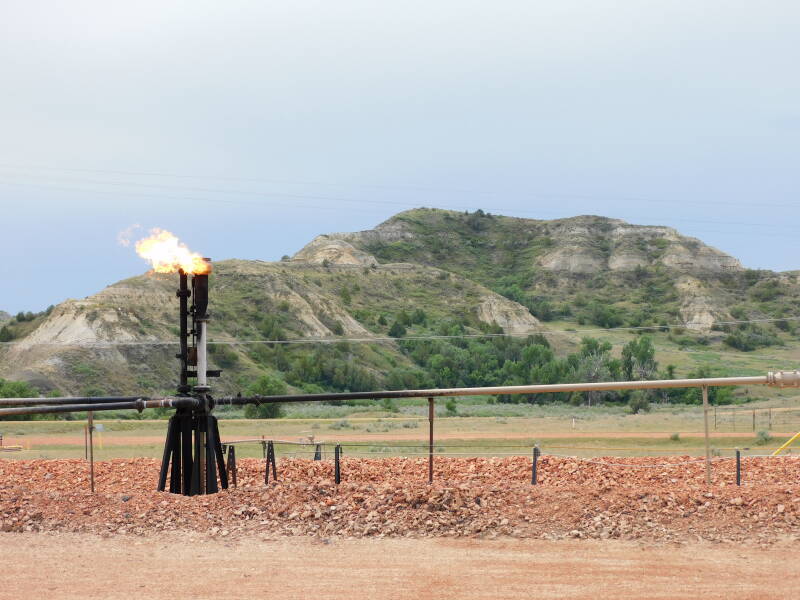
If you've ever traveled through the oil fields of western United States, chances are you've spotted a tall metal tower with a bright flame dancing at the top. This is called a natural gas flare stack, and despite appearances, it isn't there simply to burn fuel for the sake of it.
A flare stack is a safety system designed to burn off excess natural gas that comes out of an oil well alongside crude oil. While it may seem wasteful at first glance, the flame represents a much more complicated balance between geology, engineering, economics, and environmental responsibility. In many cases, companies would actually prefer to capture and sell that gas, but doing so isn't always practical.
More Than Just Oil
Every oil well produces more than just crude oil. Oil is commonly accompanied by associated natural gas, which is made up primarily of methane. The oil can be loaded onto trucks, railcars, or pipelines and transported relatively easily. Natural gas, however, is much harder to manage. It can't simply be stored in tanks and hauled away. Instead, it requires gathering pipelines, compressor stations, and processing facilities before it can reach homes, businesses, or power plants.
This raises an obvious question: If natural gas is valuable, why not capture all of it?
Why Don't Companies Just Build More Pipelines?
The answer usually comes down to one thing: cost.
Constructing a gas gathering system is incredibly expensive. A single gathering pipeline can cost anywhere from hundreds of thousands to several million dollars per mile, depending on terrain, permitting requirements, and pipe diameter. On top of that, companies must install compressors, separators, and processing plants before the gas is ready for the commercial pipeline network.
When a new oil field begins producing, that infrastructure often doesn't exist yet. Building it can take years, while the well may already be producing thousands of dollars' worth of oil every day.
If operators waited until every pipeline was completed before producing oil, they could lose millions of dollars in revenue. Instead, they begin producing the oil immediately while temporarily flaring the natural gas until the infrastructure catches up.
Is It Worth Capturing?
Not always.
Although natural gas has value, oil is generally worth much more on a per-well basis. If connecting a relatively small gas stream requires spending several million dollars on infrastructure, it may take years before that investment pays for itself.
From a business standpoint, it often makes more financial sense to continue selling the high-value oil while temporarily flaring the lower-value byproduct.
Fortunately, the situation has improved dramatically across the United States over the past decade. As gathering pipelines have expanded and companies have invested in better infrastructure, far more natural gas is being captured instead of burned. In 2018 and 2019, approximately 1.3% of all U.S. natural gas production was vented or flared. By 2023, that figure had fallen to an estimated 0.5%, the lowest rate recorded in nearly two decades. While flaring still occurs, particularly at newly drilled wells or in remote areas where pipeline infrastructure is still catching up, the overwhelming majority of natural gas produced in the United States is now captured and put to use.
A Better Idea: Make Electricity Instead
One of the most interesting solutions doesn't involve pipelines at all. Instead of transporting the gas somewhere else, some companies simply use it where it comes out of the ground.
Small natural gas generators and turbines can convert the gas directly into electricity that powers drilling rigs, pump jacks, compressor stations, water treatment equipment, and even worker housing.
Some companies have gone a step further by partnering with mobile data centers, using natural gas that would otherwise be flared to power large computer systems. Rather than wasting the fuel, they're turning it into usable electricity within a matter of minutes after it leaves the well.
For remote oil fields, this can be far cheaper than building miles of new pipeline while still putting the gas to productive use.
It also raises an interesting question: Could more remote communities or industrial facilities someday be powered this way? As portable power generation becomes more efficient, that possibility becomes increasingly realistic.
Why Burn It at all?
If the gas can't be captured or used, why not simply release it?
Because methane is an incredibly powerful greenhouse gas. Over a 20-year period, methane traps roughly 80 times more heat than the same amount of carbon dioxide. Burning methane in a flare converts it primarily into carbon dioxide and water vapor. While carbon dioxide is still a greenhouse gas, its warming effect is significantly lower than methane over the short term.
In other words, flaring isn't perfect, but it's far better than venting raw methane directly into the atmosphere.
The Environmental Cost
Even so, flaring isn't without consequences.
According to the World Bank, approximately 151 billion cubic meters of natural gas were flared worldwide in 2024, releasing an estimated 389 million metric tons of carbon dioxide equivalent into the atmosphere. To put that into perspective, the amount of natural gas burned in flare stacks each year is roughly equal to the total annual natural gas consumption of the entire continent of Africa. Energy that could otherwise heat homes, generate electricity, or power industries.
A Small Flame Tells a Much Bigger Story
The next time you see a flare stack glowing against the prairie sky, remember that you're witnessing much more than a burning flame.
That fire tells the story of an oil well producing multiple resources at once. It reflects the challenge of balancing infrastructure costs with energy production, protecting the environment while maintaining safety, and finding new technologies that can turn what was once considered waste into something useful.
Sometimes, one small flame can tell a surprisingly big story.
Add comment
Comments