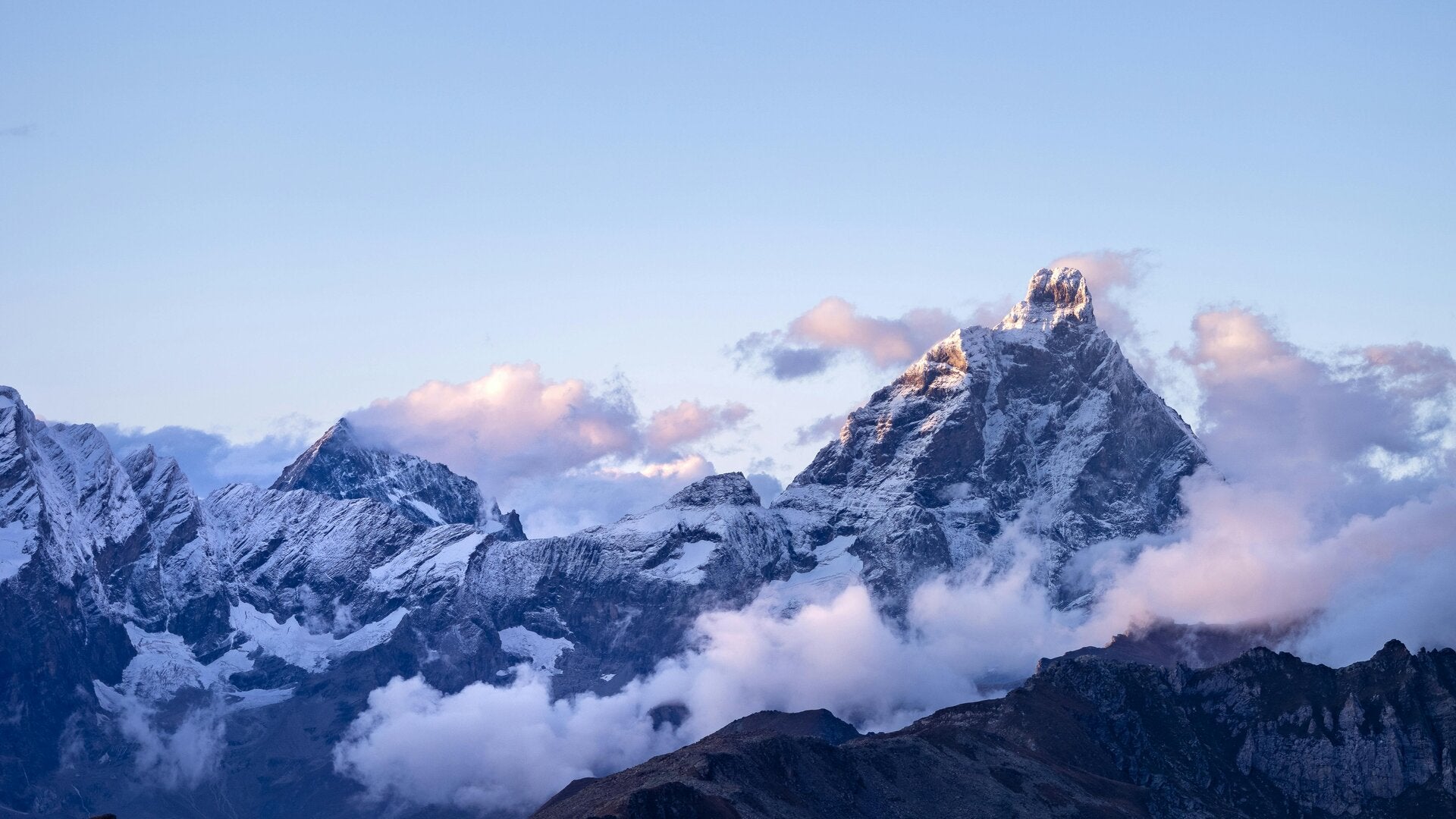
When we think of giant mountain ranges, the Himalayas usually come to mind. Yet compared to some of Earth's ancient mountain systems, the Himalayas may be relatively modest. Throughout geologic history, continental collisions have assembled supercontinents and produced immense "supermountains" that stretched thousands of kilometers across the globe. These ancient ranges not only reshaped Earth's surface but may have played a critical role in the evolution of life itself.
What Is a Supermountain?
A supermountain is an exceptionally large mountain belt formed during the collision of continents as supercontinents assemble. These ranges can rival or exceed the scale of today's Himalayas and often extend across much of a newly formed supercontinent.
Unlike modern mountain ranges, supermountains are usually recognized through the remnants they leave behind: deeply metamorphosed rocks, thick sedimentary deposits, and zircon grains preserved in younger rocks.
Three of the most significant supermountain-building events occurred during the assembly of the supercontinents:
- Nuna (also called Columbia) ~2.0–1.8 billion years ago
- Rodinia ~1.3–0.9 billion years ago
- Gondwana/Pangea ~650–250 million years ago
Among these, the Nuna and Rodinia supermountains may have had profound effects on Earth's biosphere.
The Nuna Supermountain
Around 2 billion years ago, Earth's continents collided to form the supercontinent Nuna. This collision produced what some geologists refer to as the Nuna Supermountain, a massive mountain chain potentially stretching over 8,000 kilometers.
The erosion of these mountains released enormous quantities of nutrients into rivers and oceans. Phosphorus, iron, and other elements essential for biological productivity became increasingly available in marine environments.
Coincidentally, this period overlaps with the rise and diversification of eukaryotes, organisms whose cells contain nuclei and other specialized structures. While correlation does not prove causation, many researchers suggest that increased nutrient delivery from weathering supermountains may have helped support more complex forms of life.
From Mountains to Oceans
Mountains are not just piles of rock. They act as giant chemical reactors.
As rainfall and rivers break down uplifted rock, nutrients are transported into the oceans. Increased weathering delivers phosphorus needed for biological growth and supplies trace metals that support a variety of metabolic processes. At the same time, the weathering of silicate rocks removes carbon dioxide from the atmosphere, helping regulate Earth's climate over long timescales. These processes can significantly alter ocean chemistry and influence global climate, demonstrating how mountain building can affect the entire planet.
The larger the mountain range, the larger these effects become. This means that supermountains can potentially alter Earth's environment over hundreds of millions of years.
The Rodinian Supermountain and the Rise of Complex Life
Perhaps the most famous example is the Rodinian Supermountain.
During the assembly of Rodinia between approximately 1.3 and 0.9 billion years ago, continent-scale collisions produced an immense mountain belt that may have rivaled or exceeded the Himalayas. Some estimates suggest it could have stretched as far as the Nuna Supermountain, over 8,000 kilometers.
The timing is intriguing. Soon after the peak of Rodinian mountain building, Earth experienced major evolutionary innovations, including the diversification of eukaryotes and the eventual emergence of multicellular organisms. The increased erosion of the Rodinian Supermountain likely delivered large amounts of phosphorus and other nutrients into the oceans.
This nutrient pulse may have increased biological productivity, oxygen production, and ecological complexity, helping prepare the stage for the later appearance of animals.
Supermountains and Snowball Earth
The influence of supermountains may extend beyond biology.
Intense weathering of uplifted silicate rocks consumes atmospheric carbon dioxide. If weathering rates become sufficiently high, global temperatures can decline.
Some researchers have suggested that the weathering of the Rodinian Supermountain contributed to the climatic conditions that eventually led to the Cryogenian "Snowball Earth" glaciations between approximately 717 and 635 million years ago.
Although the exact mechanisms remain debated, the connection demonstrates how mountain-building can influence climate on a planetary scale.
Why Zircons Matter
Evidence for these ancient mountain belts often comes from tiny zircon crystals.
Zircons are remarkably durable and can survive multiple cycles of erosion and deposition. During periods of intense mountain building, large volumes of crust are produced and subsequently eroded, generating abundant zircon grains.
Geologists determine the age of zircons using uranium–lead (U–Pb) radiometric dating. Zircon crystals readily incorporate uranium atoms into their crystal structure when they form but strongly reject lead. Because uranium isotopes decay into lead at known rates over billions of years, measuring the ratios of uranium to lead within a zircon allows scientists to calculate when it crystallized. This makes zircons some of the most reliable natural timekeepers in the geologic record.
Global zircon ages correspond closely with major supercontinent assembly events. These ages provide geologists with a valuable record of when ancient supermountains formed and when they were being eroded.
In many ways, zircons are the surviving fingerprints of mountain ranges that disappeared hundreds of millions of years ago.
Mountains That Changed the World
The mountains themselves are gone. Billions of years of erosion have reduced them to roots buried deep within Earth's crust. Yet their legacy remains.
Ancient supermountains helped shape continents, altered global climate, changed ocean chemistry, and may have provided the nutrients necessary for increasingly complex life to evolve.
The next time you look at a mountain range, imagine one stretching from horizon to horizon across an entire supercontinent. Those vanished giants may have done far more than reshape Earth's surface, they may have helped create the conditions that allowed complex life, including ourselves, to ever exist.
Add comment
Comments